
What Makes a Quest Worth Doing
Actions that change a world

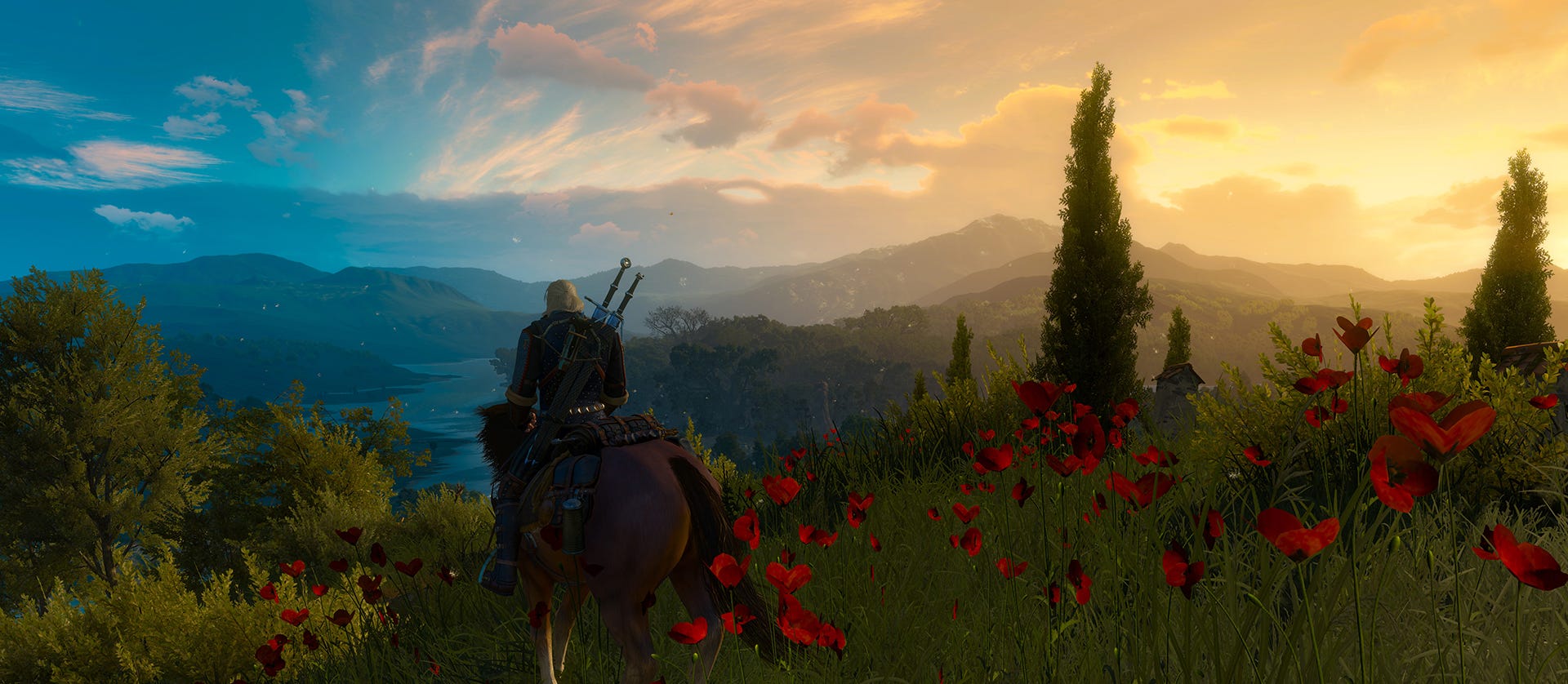
There is a quest in The Witcher 3 where you help an old woman find her frying pan. It sounds like exactly the kind of errand that gives quest design a bad reputation. Fetch this, bring that, here is your XP. But it’s not. It’s funny, it’s human, it respects your time, and it says something specific about the world you’re in. The pan matters because the woman matters. That’s it. That’s the whole trick.
Quest design is one of those disciplines that looks simple from the outside and turns out to be load-bearing for almost everything else in a game. Get it wrong and players stop caring. Get it right and they are still thinking about your game years later. This is what I’ve learned from years of designing quests and systems.
What a Quest Actually Is
Before getting into what makes quests work, it helps to be precise about what a quest actually does. At its most mechanical, a quest is a structure with three parts: an unlocking condition, a completion requirement, and a reward. The player becomes eligible for it at some point, does a thing, and gets something back.
That’s the skeleton. The mistake a lot of designers make is thinking the skeleton is the quest. It isn’t. The skeleton is just the delivery mechanism. What the player actually experiences is everything wrapped around it: why they care about the objective, what the world tells them while they’re doing it, and whether the outcome felt like it mattered.
A quest that says “collect 10 wolf pelts” and a quest that says “gather medicine for a sick child” can have identical mechanical structures. Same unlock condition, same completion trigger, same reward value. The difference is entirely in the layer of meaning around them. Context turns a chore into a story beat.
The Quest States You Need to Track
One thing that doesn’t get talked about enough in design writing is the lifecycle of a quest from the system’s perspective. Designers think a lot about what the quest feels like to play and less about how it behaves as a data object. Both matter.
A well-built quest system tracks at least five states: pending, in progress, completed, done, and cancelled. Pending means the player hasn’t met the conditions to see it yet. In progress means it’s active and being tracked. Completed means the objective is met but the reward hasn’t been collected. Done means the full loop is closed. Cancelled is the one most designers forget, and it’s the one that causes the most problems.
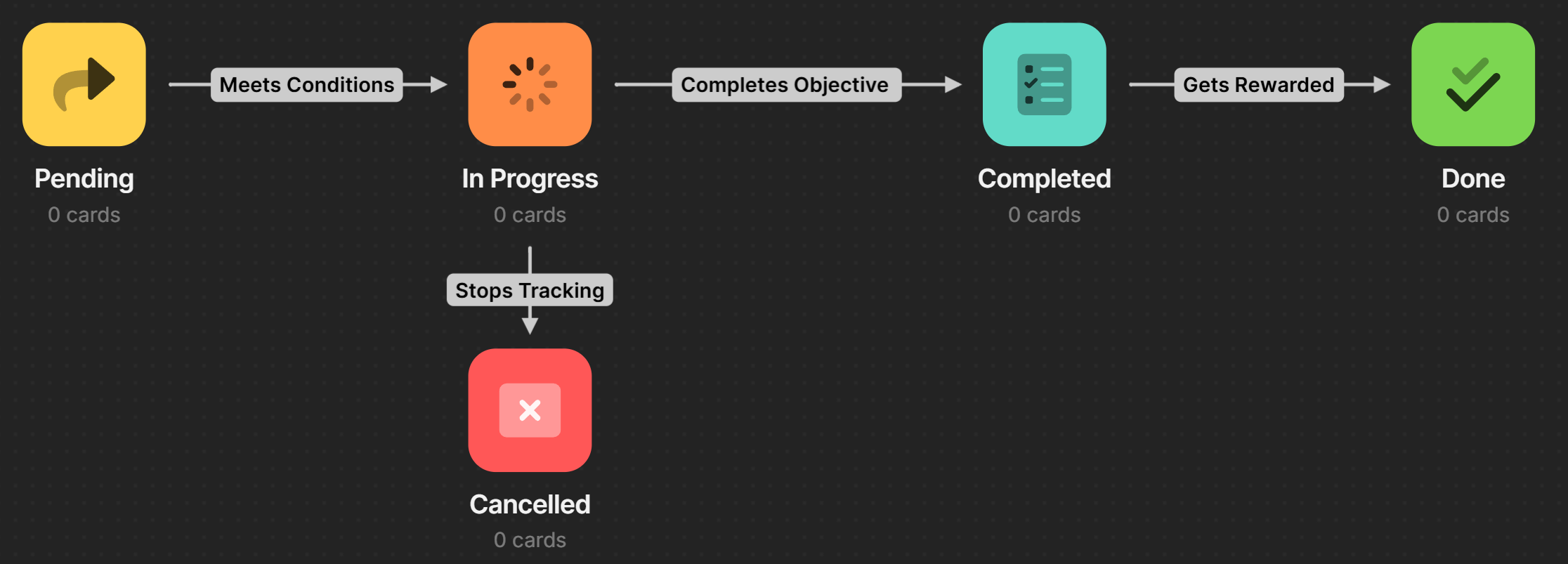
Cancellation matters because players progress at different rates. A beginner quest that never cancels will still be sitting in the journal of a player who is thirty hours in and doesn’t need it anymore. That clutters the experience and signals to the player that the system isn’t paying attention to them. Tying cancellation to a progress threshold, or to the completion of a later quest that supersedes it, keeps the journal clean and the game feeling responsive.
The Two Kinds of Completion
There’s a distinction in quest design that sounds technical but has real design implications: the difference between game state-based completion and ad-hoc action-based completion.
Game state completion means the quest checks whether the player has reached a certain condition at the moment of evaluation. If you need 500 gold and you already have 500 gold when the quest is assigned, it completes immediately. That’s not always a bug. Sometimes it’s a reward for players who were already engaged with the game’s systems. But it can also rob the player of the experience of working toward something.
Ad-hoc completion tracks actions taken after the quest became active. You need to harvest 50 apples from this point forward, regardless of what you’ve already done. This is slower, but it creates a genuine arc. The player has a before and after. They did something because the quest asked them to, which means the quest had weight.
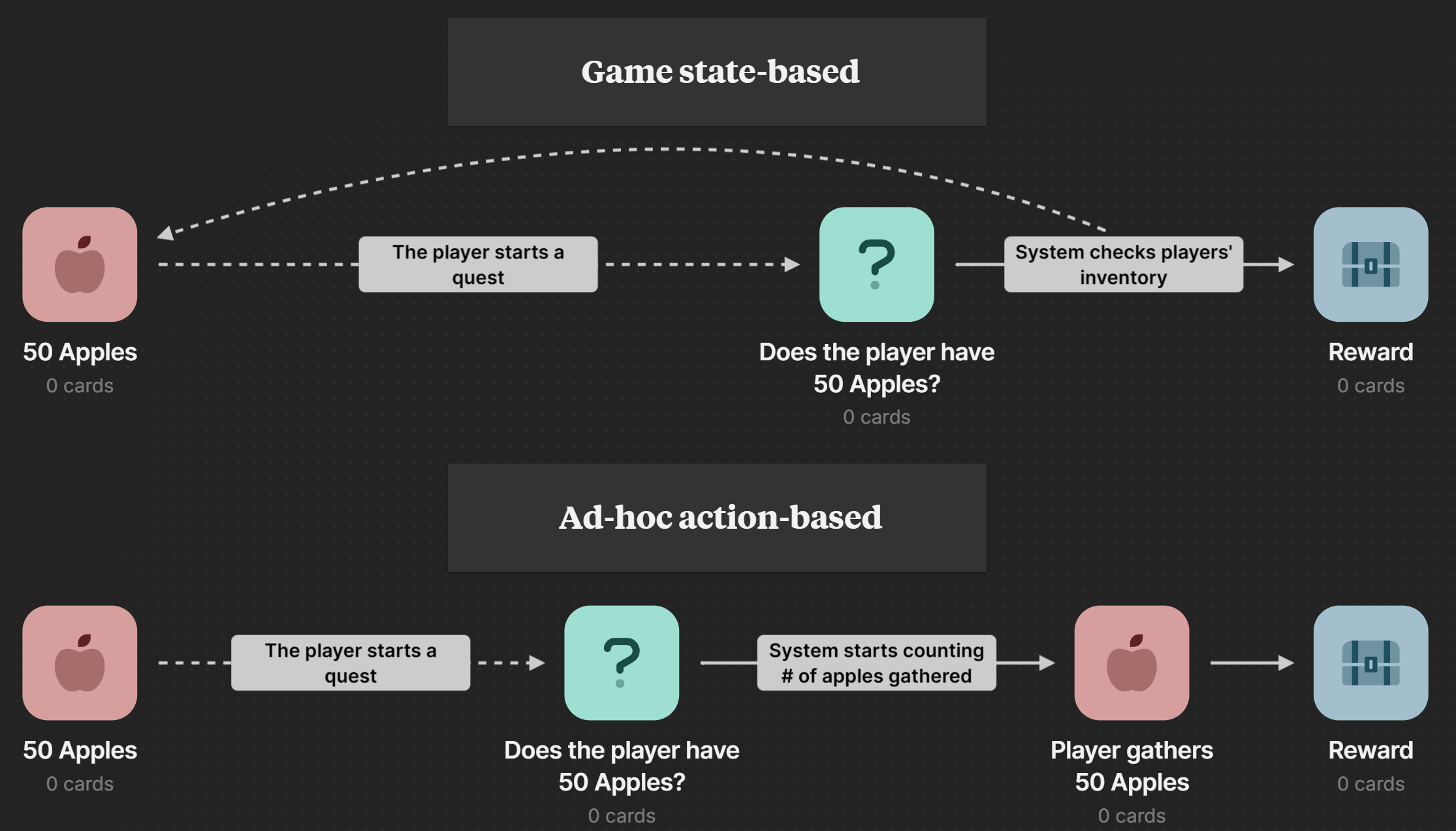
Most quest systems use both, and knowing which to reach for depends on what the quest is trying to do. If you’re teaching a mechanic, ad-hoc is almost always right. If you’re rewarding prior engagement or validating existing behaviour, game state completion can feel like a nice acknowledgement. Either way, the choice should be deliberate.
Player Agency Is Not Just Branching Dialogue
There’s a tendency in design circles to treat player agency in quests as a binary: either a quest has branching choices or it doesn’t. That framing is too narrow and leads to a lot of false conclusions about what makes quests feel meaningful.
Real agency is about whether the player feels like a participant rather than a passenger. Branching dialogue can create that feeling, but so can approach flexibility “Can I solve this through stealth or through combat?”, information asymmetry “What do I actually know versus what am I being told?”, and consequence visibility “Does the world respond differently based on what I did?”.
Going back to the starting game example, the Witcher 3 does this well not because every quest has a dramatic moral fork, but because quests consistently treat the player as someone whose perspective matters. You investigate before you act. You talk to multiple parties. You form an opinion. By the time you make a choice, it feels like yours because you understand the situation. That’s a design achievement, and it’s reachable in smaller scopes than most people assume.
The moments players tend to remember most are rarely the biggest choices. They’re the smaller signals: an NPC who reacts differently because of something you did two hours ago, an environmental clue the quest text never mentioned, a resolution where neither option felt obviously correct. Those details tell the player the world is paying attention.
Players often prefer a clear indication on how their actions are changing the game world around them.
Pacing Inside a Quest
Quests have their own internal pacing arc, separate from the broader rhythm of the game. A well-paced quest moves through distinct phases: setup, where the player understands the stakes; pursuit, where they’re actively working toward the objective; and resolution, where the outcome lands with appropriate weight.
The most common pacing failure is front-loading. Designers spend time on the setup, get excited about the resolution, and treat the pursuit as connective tissue between the two. The result is quests that feel padded in the middle. The player already knows where they’re going and just wants to get there.
The fix is to make the pursuit interesting in its own right. That means varying the activities within it, introducing at least one unexpected complication, and making sure every step tells the player something new, whether about the world, a character, or a mechanic. The middle of a quest should change something. If it doesn’t, it’s filler.
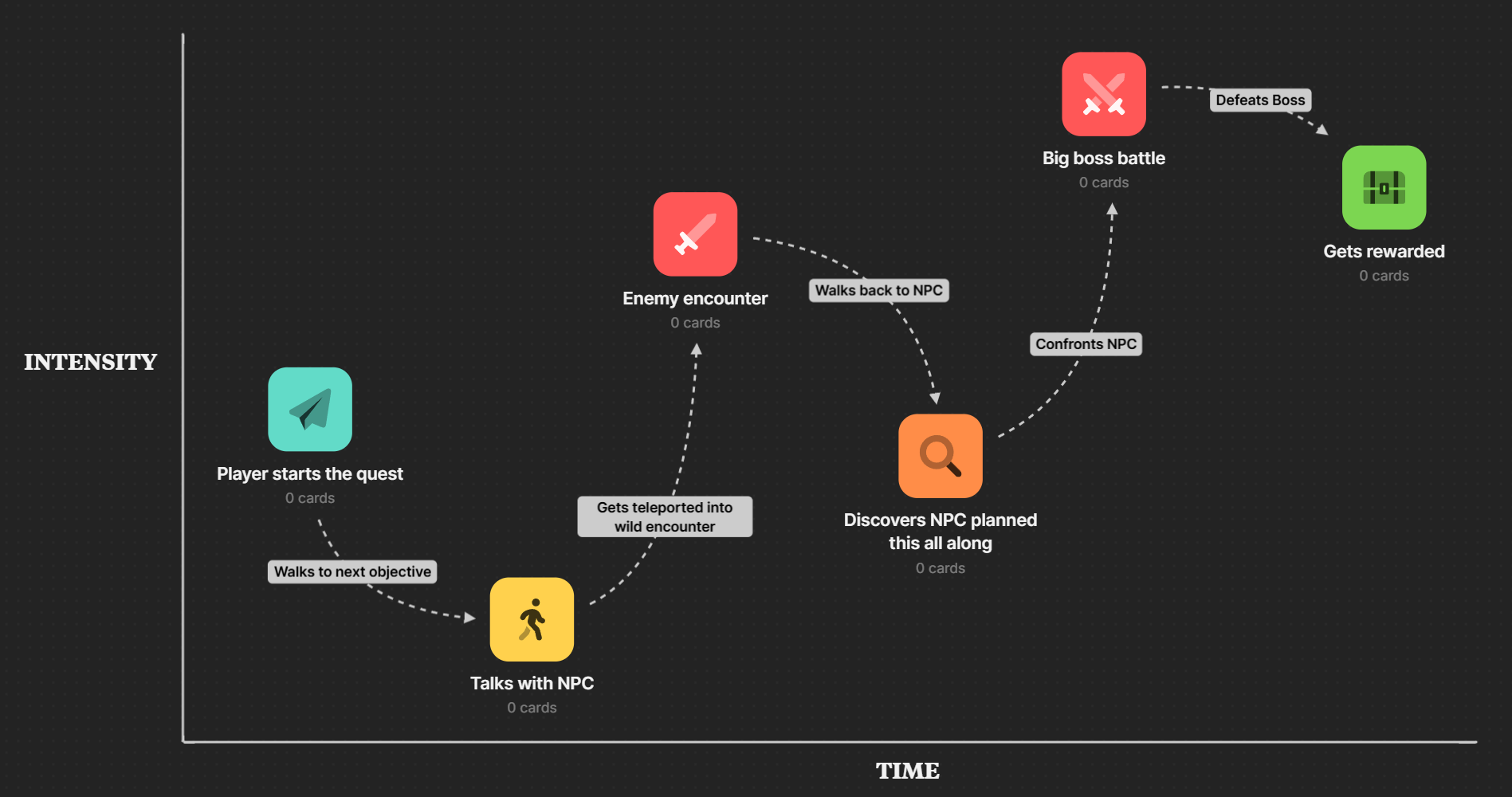
Not all quests need to have a plot twist, but does help exemplify this argument.
The escalation principle from level design applies here too. You can plot a rough intensity curve through a quest and ask at each beat whether you’re building toward something or just marking time. If a section is all valleys with no peak anywhere near, that’s where players start opening the map or checking their phone.
The MMORPG Problem
Designing quests for a multiplayer persistent world introduces constraints that single-player designers don’t face, and most quest design writing skips over them entirely.
In a single-player game, a quest can change the world. You save the village, the village is saved. In an MMORPG, thousands of players are saving the village simultaneously, which means the village can never actually be saved. The state resets. The NPC who was in danger is in danger again five minutes later.
Players know this. They know the quest is on rails. That awareness erodes the feeling of consequence that makes quests meaningful in the first place. The challenge is finding ways to create the emotional texture of consequence without the permanence a single-player game can afford.
The approaches that work tend to keep the scope of consequence personal rather than world-level. Your character’s journal reflects what happened. An NPC remembers you specifically. A reward is unique to your playthrough. The world doesn’t change, but your relationship to it does. That’s enough, if you commit to it consistently.
It’s also worth noting that in a live multiplayer game, community behaviour around your quest content is some of the most honest feedback you’ll ever receive. When players start building external guides and sharing solutions, that tells you the quests had depth worth mapping.
When they don’t engage at all, that tells you something too.
A Few Things Worth Remembering
Details are only valuable when they have meaning behind them. Overdesign is a real failure mode, and it comes from designers who love their own systems more than they love the player’s experience of those systems.
Quest design can become precious. You build a quest with seventeen variables and four resolution paths and a hidden fifth outcome, and then watch a playtester walk past the quest giver entirely because the icon wasn’t visible enough.
Simplicity is hard to value when you’re deep in a system. But the quests that stay with players are rarely the most mechanically complex ones. They’re the ones that felt honest. That knew what they wanted to say and said it clearly. The frying pan quest in Witcher 3 has maybe four lines of dialogue and one objective. It works because every element of it is doing something.
Quest design is one of the few disciplines where the gap between “technically complete” and “actually good” is enormous and invisible. A quest can be fully functional, bug-free, balanced, and completely forgettable. The systems work and nobody cares.
A game is not a life simulation, it is entertainment - CD Projekt RED’s quest director Pawel Sasko.
In the end, what closes that gap is authorial intent. Knowing what a quest is supposed to make the player feel, and checking every decision against that standard. Does the setup earn the resolution? Does the middle section move? Does the NPC have a reason to exist beyond delivering the objective? Is there something here that couldn’t exist in a different game?
Those questions don’t add time to production if you ask them early. They add a lot of time if you ask them in the final month.
Thomas Guana is a Senior Game & Level Designer with 4+ years of experience in game development. He led the level design team on The Forgotten Runiverse, a browser-based fantasy MMORPG developed by Bisonic Inc., released in 2025.